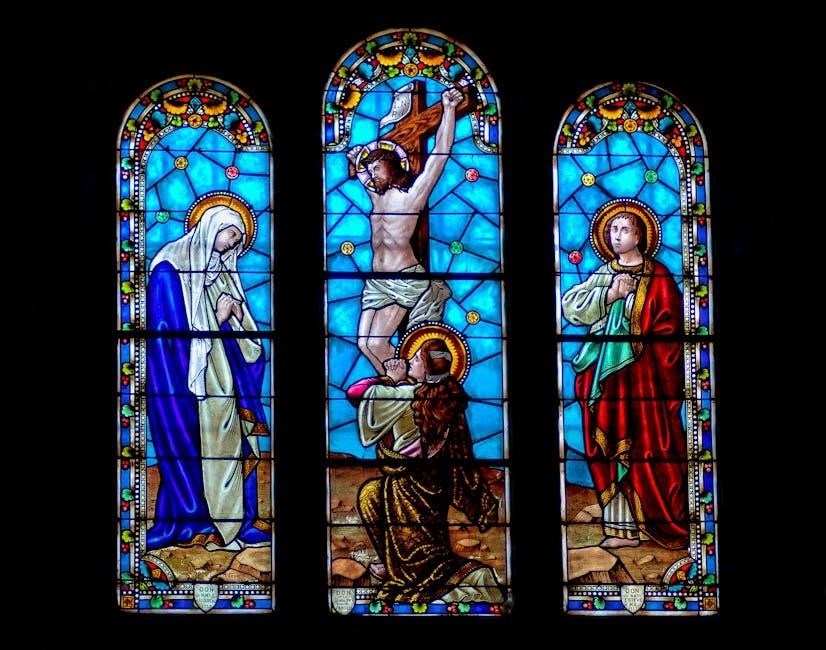
John’s Gospel, penned around A.D. 90-100, distinctly proclaims Jesus as the Christ, the Son of God. Its central aim is to foster belief, leading to eternal life through understanding Jesus’ divine nature.
A. Authorship and Date
Traditionally, the Gospel of John is attributed to the Apostle John, the “beloved disciple” mentioned throughout the text. However, scholarly debate exists regarding direct authorship, with some suggesting a Johannine community shaped the final form. Internal evidence points to an eyewitness account, yet the writing style and theological depth suggest a period of reflection and communal interpretation.
Determining the precise date is challenging. Most scholars place the completion of John between A.D. 90 and 100, making it the latest of the four Gospels. This later date explains its distinctiveness, building upon the theological foundations laid by Matthew, Mark, and Luke. The absence of direct references to the destruction of the Temple in A.D. 70 supports a date before or shortly after this event, while its developed theological framework suggests a period of mature Christian reflection.
B. Purpose and Audience
John’s Gospel possesses a clear evangelistic purpose: to persuade readers to believe that Jesus is the Christ, the Son of God, and that believing in Him results in eternal life. Unlike the Synoptic Gospels, which emphasize Jesus’ kingdom message, John focuses on Jesus’ divine identity and relationship with the Father. It aims to deepen faith, not merely recount events.
The intended audience is likely a diverse group of both Jewish and Gentile Christians, potentially facing persecution or theological challenges. John addresses those already familiar with Old Testament scripture, interpreting Jesus through that lens. The Gospel’s sophisticated theological language and symbolic imagery suggest a readership capable of nuanced understanding. It seeks to strengthen their faith and equip them to witness to others about Jesus’ saving power and eternal life offering.
C. Key Themes: Divinity of Christ
The divinity of Christ is paramount in John’s Gospel, consistently presented through unique language and profound claims. John portrays Jesus not merely as a prophet or teacher, but as God incarnate – the Word who was with God and is God (John 1:1). This is demonstrated through Jesus’ “I AM” statements, echoing God’s name in the Old Testament, and asserting His divine authority.
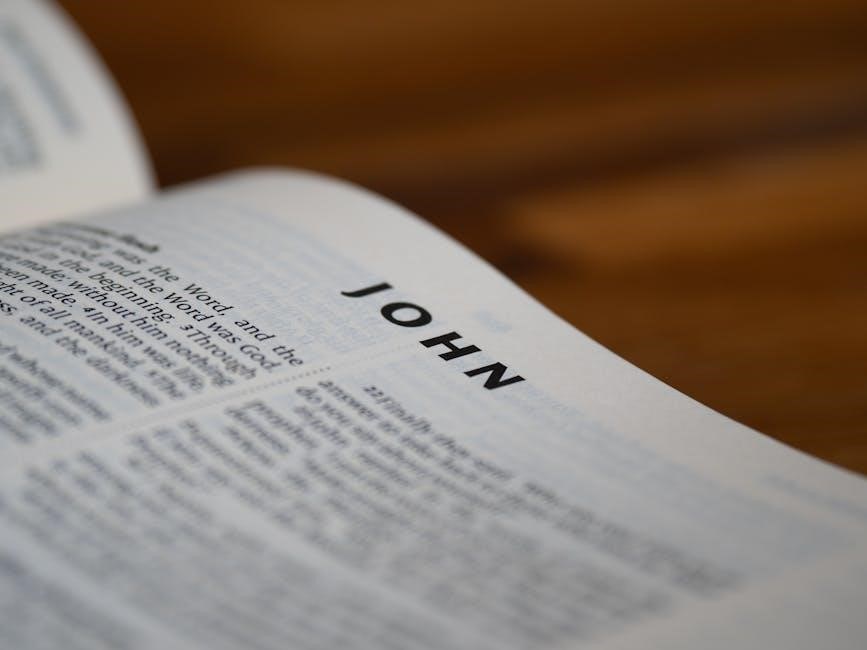
Jesus’ miracles are not simply acts of power, but revelations of His glory and divine nature. He claims equality with the Father, accepts worship, and forgives sins – prerogatives belonging to God alone. The Gospel culminates in Jesus’ crucifixion, framed not as defeat, but as a return to the Father, solidifying His divine sonship. John meticulously builds a case for Jesus’ pre-existence, eternal nature, and ultimate unity with God.
D. Key Themes: Eternal Life
Eternal life is a central, recurring theme throughout John’s Gospel, presented not as mere longevity, but as a quality of life – a present and intimate relationship with God through Jesus Christ. This isn’t earned through good works, but received as a gift through faith in Jesus (John 3:16). Jesus declares He is the resurrection and the life, offering this eternal quality to those who believe in Him.
John emphasizes that knowing God, and consequently knowing Jesus whom He sent, is eternal life (John 17:3). This knowledge isn’t intellectual assent, but a transformative encounter leading to a new birth and a life characterized by love, joy, and obedience. Jesus’ high priestly prayer (John 17) explicitly requests eternal life for believers, highlighting its importance. The Gospel portrays Jesus as the giver of this life, freely offering it to all who will receive it.

II. Prologue (John 1:1-18)
John’s prologue introduces the Word, identifying Him as God and the source of life and light, revealing God through incarnation and divine revelation.
A. The Word as God (1:1-3)
John 1:1-3 establishes the foundational truth of the Gospel: “In the beginning was the Word, and the Word was with God, and the Word was God.” This profound declaration asserts the pre-existence of the Word, existing eternally with God. The phrase “was God” doesn’t imply the Word became God, but rather affirms His inherent divine nature.
This isn’t merely a powerful being, but God Himself. The Word shares the very essence and attributes of God the Father. Verse 2 emphasizes the eternal relationship – the Word was with God, indicating distinct personhood within the Godhead.
Verse 3 then states, “All things were made through him, and without him was not any thing made that was made.” This highlights the Word’s role as the agent of creation, demonstrating His power and authority. Nothing came into existence without His involvement, solidifying His divine status and preeminence. This establishes the Word as not just *a* god, but *God* – the creator and sustainer of all things.
B. The Word as Light and Life (1:4-9)
John 1:4-9 builds upon the declaration of the Word’s divinity, introducing the concepts of light and life. The Word is life, and this life serves as the light for all humanity. This light isn’t merely illumination, but represents truth, revelation, and spiritual understanding, contrasting sharply with the darkness of sin and ignorance.
The passage emphasizes that this light shines in the darkness, yet the darkness does not overcome it. This signifies the enduring power of God’s truth, even in a world steeped in evil. The world was made through the Word, yet it did not recognize Him when He came.
This rejection isn’t universal; those who did receive Him – believing in His name – were granted the right to become children of God, born not of natural descent, but of God’s will. This highlights the transformative power of faith and the new birth offered through the Word, offering eternal life and a restored relationship with God.
C. The Word’s Rejection and Acceptance (1:10-13)
John 1:10-13 portrays a poignant paradox: the Word, though the source of creation and life, came to His own people – the Israelites – yet they did not receive Him. This rejection isn’t presented as a simple oversight, but as a deliberate turning away from the truth and the divine offer of salvation.
Despite this widespread rejection, hope remains. To those who did believe in His name, He granted the privilege of becoming children of God, a new birth not rooted in human lineage or willpower, but in God’s sovereign act. This emphasizes the transformative power of faith.
This new birth signifies a spiritual regeneration, a fresh start made possible through acceptance of the Word. The passage underscores the crucial choice humanity faces: to reject the light or embrace it, leading to either continued darkness or the promise of eternal life and divine sonship.
D. The Incarnation: The Word Becomes Flesh (1:14)
John 1:14 marks a pivotal moment – the Incarnation. The eternal Word, previously understood as divine and separate from creation, “became flesh” and dwelt among us. This isn’t merely a physical manifestation, but a complete identification with humanity, a humbling descent from glory to share in our mortal condition.
The verse emphasizes that this dwelling wasn’t a fleeting visit, but a sustained presence, allowing humanity to directly encounter God in a tangible form. This Incarnation is presented as a revelation of grace and truth, offering a pathway to relationship with the divine.
Furthermore, John states that we beheld His glory, “glory as of the only begotten of the Father.” This glory isn’t simply outward radiance, but a manifestation of God’s character and attributes, revealed through Jesus’ life, teachings, and miracles. It’s a glory full of grace and truth.
E. Glory of the Incarnate Word (1:14-18)
Following the declaration of the Word becoming flesh, John 1:14-18 elaborates on the glory of this incarnate Word. This glory isn’t self-generated; it’s described as “glory as of the only begotten of the Father,” directly linking Jesus’ radiance to the divine source.
This glory is further illuminated by the contrast with the Law given through Moses. While the Law brought truth, grace and truth came through Jesus Christ. The Law revealed God’s standards; Jesus is God’s revelation, embodying both justice and mercy.

No one has ever seen God directly, but the Word, who is God, has made Him known. Jesus, therefore, functions as the ultimate interpreter of the Father’s character, unveiling divine nature through His life and teachings. This unveiling isn’t merely intellectual understanding, but experiential knowledge of God’s love and truth.

III. The Book of Signs (John 1:19 – 12:50)
John presents seven “signs” – miracles – demonstrating Jesus’ divine power and identity. These acts reveal Jesus as both Redeemer and Revealer of God, prompting belief.
A. First Sign: Turning Water into Wine (John 2:1-12)
Jesus’ first public miracle, occurring at a wedding in Cana, dramatically reveals His glory and initiates belief among His disciples. Faced with a social embarrassment – a lack of wine – Jesus intervenes, instructing servants to fill six stone water jars, each holding twenty to thirty gallons.
Remarkably, the water is transformed into high-quality wine, exceeding expectations. This act isn’t merely a solution to a logistical problem; it’s a symbolic unveiling of Jesus’ power and a foreshadowing of the “new wine” of the Kingdom of God. The master of the banquet, unaware of the miracle’s source, praises the wine’s quality, highlighting its unusual timing.
John emphasizes that this sign is the first of many, intended to manifest Jesus’ glory and draw people to faith. The disciples, witnessing this display of divine power, begin to believe in Jesus, solidifying their commitment to following Him. This miracle establishes a pattern of Jesus responding to human need with extraordinary grace and power.
B. Second Sign: Healing the Official’s Son (John 4:46-54)
Jesus travels to Cana again, prompting a desperate plea from a royal official whose son is near death. The official implores Jesus to come and heal his child, demonstrating a belief that, while hesitant, recognizes Jesus’ potential. Jesus responds with a seemingly discouraging statement, “Unless you see signs and wonders, you will not believe,” challenging the official’s faith.
Despite this, the official persists, trusting in Jesus’ power even from a distance. Jesus declares that his son will live, and remarkably, the boy recovers at the exact hour Jesus speaks. The official, along with his entire household, believes in Jesus as a result of this miraculous healing.
This sign highlights Jesus’ authority over life and death, and the power of faith, even when tested. It demonstrates that belief doesn’t require physical presence, but rather a willingness to trust in Jesus’ word. This miracle further establishes Jesus’ divine power and expands the reach of His ministry.
C. Third Sign: Healing the Paralytic at the Pool of Bethesda (John 5:1-18)
Jesus encounters a paralytic man who has been waiting for thirty-eight years at the pool of Bethesda, hoping to be healed when the water is stirred by an angel. Showing compassion, Jesus asks the man if he wants to get well, a seemingly rhetorical question revealing a deeper spiritual need.
Without being asked, Jesus commands the man to rise, take his mat, and walk. Immediately, the man is healed and begins to walk, but this occurs on the Sabbath, drawing criticism from Jewish leaders who accuse Jesus of violating Sabbath laws.
Jesus defends Himself, asserting that His Father is working, and He is simply continuing that work. He emphasizes that the Father’s work doesn’t cease on the Sabbath, and neither should His. This sign reveals Jesus’ authority not only over physical ailments but also over religious interpretations, foreshadowing His claims to divinity and challenging established traditions.
D. Fourth Sign: Feeding the Five Thousand (John 6:1-15)
Jesus miraculously feeds a large crowd of over five thousand people with only five loaves of bread and two small fish, provided by a young boy. This event takes place near the town of Bethsaida, demonstrating Jesus’ power and compassion towards those in need. Jesus directs Philip to calculate how much bread would be needed, but the miracle transcends logistical limitations.
Jesus gives thanks to God for the food, then distributes it to the disciples, who in turn distribute it to the crowd. Remarkably, everyone is filled, and afterward, twelve baskets of leftover fragments are collected, highlighting the abundance of Jesus’ provision.
This sign powerfully illustrates Jesus as the “Bread of Life,” foreshadowing the Eucharist and offering spiritual nourishment beyond physical sustenance. It reveals Jesus’ ability to meet both physical and spiritual hunger, pointing to His role as the ultimate provider and sustainer of life.

IV. Key Discourses in John
John’s Gospel uniquely features extended dialogues between Jesus and Jewish leaders, exploring themes of truth, life, and judgment through profound, theological discussions.
A. Discourse on the Bread of Life (John 6:22-59)
Following the miraculous feeding of the five thousand, Jesus delivers a pivotal discourse in John 6:22-59, centered around the concept of being the “Bread of Life.” He challenges his audience to move beyond seeking merely physical sustenance, urging them to pursue the spiritual nourishment He offers.
Jesus emphasizes that this “bread” is not earthly food, but rather Himself – the one sent from the Father to provide eternal life. He declares that those who believe in Him will never hunger or thirst, and promises a deeper, more satisfying fulfillment than anything the world can offer.
The discourse intensifies as Jesus speaks of eating His flesh and drinking His blood, a shocking statement that leads to confusion and offense among His listeners. He clarifies this as a call to receive Him through faith, embracing His sacrifice for their salvation. This discourse powerfully reveals Jesus’ identity and the necessity of spiritual communion with Him for eternal life.
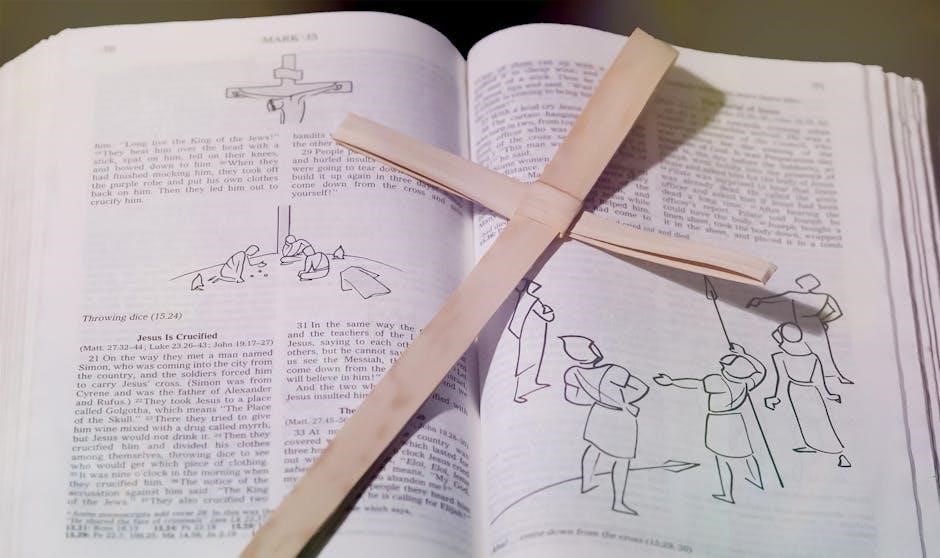
B. Discourse on the Light and Judgment (John 8:12-59)
Within John 8:12-59, Jesus proclaims Himself as the “Light of the world,” contrasting sharply with the spiritual darkness of those who reject Him. This discourse unfolds amidst escalating conflict with Jewish leaders, who question His authority and accuse Him of blasphemy.
Jesus asserts that His testimony is true, rooted in His relationship with the Father. He challenges those who oppose Him to examine their own hearts and motives, exposing their inability to comprehend spiritual truth due to their inherent sinfulness. He reveals that their destiny is bound to their lineage – those born of sin remain slaves to it.
The discourse culminates in a dramatic confrontation where Jesus declares His pre-existence (“Before Abraham was, I am”), provoking outrage and an attempt to stone Him. This powerful exchange underscores Jesus’ divine identity and foreshadows the judgment that awaits those who reject His light and truth, emphasizing the critical choice between belief and condemnation.
C. Discourse on the Good Shepherd (John 10:1-18)
In John 10:1-18, Jesus employs the compelling metaphor of the Good Shepherd to illustrate His relationship with His followers. He contrasts Himself with false leaders – the “thieves and robbers” – who seek to exploit the flock for personal gain, lacking genuine care or concern for their well-being.

The Good Shepherd, Jesus explains, lays down His life for the sheep, demonstrating ultimate love and sacrifice. He knows His sheep intimately, and they recognize His voice, signifying a deep, personal connection built on trust and obedience. This intimate knowledge ensures safety and guidance, protecting them from harm.
This discourse emphasizes Jesus’ authority, protection, and eternal life offering to those who believe in Him. He promises abundant life, not merely existence, but a fullness found only through following Him. The imagery powerfully conveys Jesus’ role as the ultimate provider and protector, offering a secure and fulfilling relationship with the Father.
V. The Book of Glory (John 13-21)
This section details Jesus’ final hours, including the Last Supper, High Priestly Prayer, Passion, and glorious Resurrection, revealing His return to the Father.
A. The Last Supper and Foot Washing (John 13-17)
John’s account of the Last Supper uniquely emphasizes Jesus’ humble act of foot washing (John 13:1-17), demonstrating selfless love and service to His disciples. This act serves as a model for Christian behavior, urging followers to emulate Christ’s humility.
Following the foot washing, Jesus predicts Judas’ betrayal and Peter’s denial, foreshadowing the impending suffering and sacrifice. The discourse that follows (John 14-16) centers on preparing the disciples for His departure and assuring them of the Holy Spirit’s arrival as their advocate and guide.
Jesus offers comfort, promising an abiding presence and eternal dwelling places for believers. He emphasizes the importance of love, obedience, and remaining in Him to bear fruit. This culminates in the profound intimacy of Jesus’ farewell address, laying the groundwork for the High Priestly Prayer.
B. Jesus’ High Priestly Prayer (John 17)
John 17 presents Jesus’ intimate and profound prayer offered on behalf of His disciples and all future believers. This prayer, often called the High Priestly Prayer, reveals Jesus’ deep concern for the unity and sanctification of those who would follow Him. He petitions the Father for protection, not to remove them from the world, but to keep them from the evil one.
Jesus prays for the glorification of the Father through the completion of His mission on earth. He emphasizes the importance of knowing the Father as the source of eternal life, a theme central to John’s Gospel. The prayer highlights the inseparable relationship between the Father and the Son, demonstrating their divine unity.
Ultimately, Jesus’ prayer expresses a longing for believers to experience the fullness of joy and to be with Him in glory, reflecting the promise of eternal life and a restored relationship with God.
C. The Passion and Resurrection Narratives (John 18-21)
John’s account of the Passion (John 18-19) portrays Jesus’ suffering and crucifixion with a unique emphasis on His sovereignty and control, even in the face of betrayal and unjust judgment. Unlike the synoptic Gospels, John details Jesus’ interactions with Pilate, highlighting Jesus’ kingship and the world’s rejection of Him.
The narrative culminates in Jesus’ death and burial, framing the crucifixion not as a defeat, but as a glorious return to the Father who sent Him. The subsequent Resurrection narrative (John 20-21) emphasizes Jesus’ appearances to the disciples, confirming His victory over death and offering proof of His divine identity.
John concludes with a post-resurrection appearance where Jesus restores Peter, commissioning him to “feed my sheep,” signifying a renewed call to discipleship and leadership within the early church, solidifying the promise of eternal life.